
Key Points:
- Clarence was the inventor of the Locke Adder, a row adder made of stamped tin, paper, and cloth.
- Though not very user-friendly, the machine achieved modest success over a few years due to a low price and an extensive print advertising campaign.
- The device was most likely supplanted by easier-to-use dial adders like the calcumeter and calculator.
Locke Adder
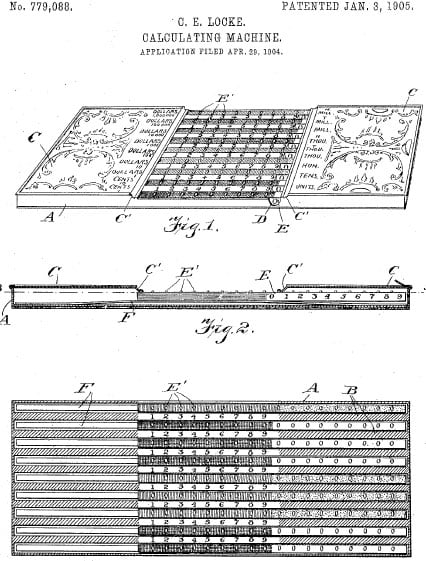
Clarence E. Locke (1866-1945) from Kensett, Iowa, USA, was a holder of 2 US and 2 German patents for a calculating device — slide bar adder, which became popular as Locke Adder. The first patent is №689680 from December 1901, and the second is №779088 from January 1905 (see the lower patent drawing). Locke was a holder also of another patent for a hand stamp (US pat. №686815).
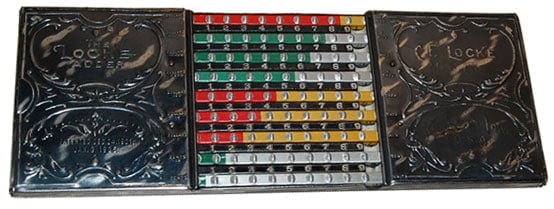
The Locke Adder (see the lower photo) is a row adder, made of metal (stamped tin), paper, and cloth, with measurements of 2 cm x 29.5 cm x 12.3 cm. It used alternating fixed and moveable horizontal bars, as carrying from one column to another is manual.
The nine moveable slides show either red or green while in the zero position and expose either silver or yellow as the slides are moved to the right. Between the slides are eight fixed bars, painted black with white numbers from 1 to 9. The sliding bars of hollow aluminum are manipulated with the fingers in order to determine sums.
The Locke Adder
©Unknown author / public domain
A number is entered on a given bar by placing the index finger on the raised knob corresponding to the desired digit and sliding the knob leftward as far as possible. The user must account for a tens carry manually by a combination of a rightward adjustment of the current bar and the advancement of the bar above by one, much as is done with a traditional abacus. The split-colored sliders aid the user in recognizing and carrying out the tens carry operation.
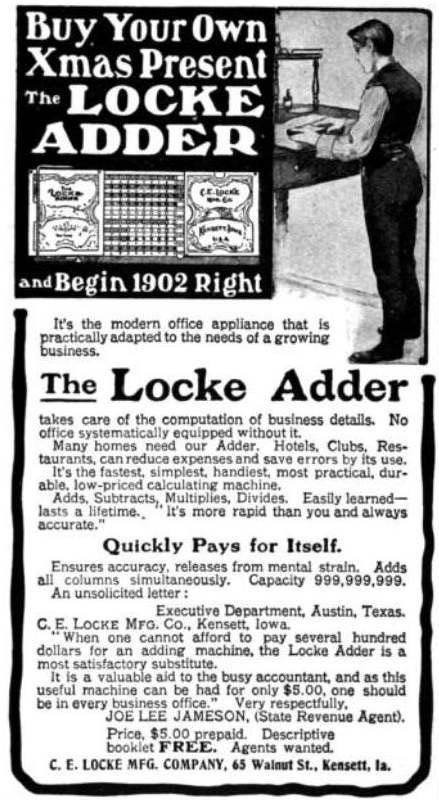
The Locke Adder was a very beautiful, but not a user-friendly calculator. It enjoyed a modest (albeit brief) success, thanks to a low price and an extensive print advertising campaign in the first few years of the 20th century (see the lower image). It was on the market for less than ten years, probably being supplanted by dial adders such as the Calcumeter and the Calculator.
The machine was manufactured by the inventor himself in his company — C. E. Locke Manufacturing Co., 98 Walnut St., Kensett, Iowa. The prices were: 1901-05: price $5; 1906/; price $5 (oxidized copper finish) and $10 (oxidized silver finish with case); 1908: price $5 & $10.
What is known about the inventor — Clarence Locke?
Clarence Elmer Locke was born in 1866 in Edgerton, Wisconsin, as the first child in the family of Charles Locke (1837-1903), a Civil War veteran and lumberyard owner and merchant from New York, and Mary Elmer Holden-Locke, (1842-1908). The family had one more son, Willbur (born 1879), and a daughter, Jessie M. (b. 1874).
Clarence Locke graduated from Cornell College in Mt. Vernon, Iowa in 1892, with a Bachelor of Civil Engineering, and in the next year, he married Frannie Locke (b. 1867). In 1905 their daughter Dorothy was born. Then Clarence worked for a time as a civil engineer in Minnesota and finally joined his father’s lumberyard business in Kensett, Iowa, where he worked as a dealer of lumber and coal.
In the 1910s Clarence Locke moved with his family to New Mexico, where he bought a farm.
Clarence Elmer Locke died on 15 July 1945, in Dona Ana, New Mexico.
The image featured at the top of this post is ©Unknown author / public domain