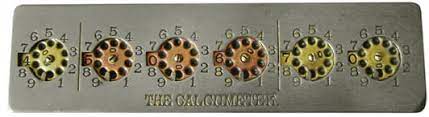

Invented by James J. Walsh, the Calcumeter was a unique device used for rapidly solving mathematical equations. The device consists of a series of dials and levers that can be manipulated to quickly determine mathematical results. For many years, the Calcumeter was the go-to device for quick addition on the go. Over time, various versions were produced in many different shapes and sizes, with five to 12 number dials. Some Calcumeters even have foldable legs that let you use them at a 45-degree angle for maximum comfort and ease of use. Although they were eventually replaced by more advanced devices, the Calcumeter was instrumental in the evolution of electronic calculators.
The Calcumeter of James J. Walsh
When we picture calculators, we picture a device that almost resembles a cell phone or a TV remote: thin, tall, not very wide, and a series of useful keys and buttons to help users make every kind of calculation imaginable. It hasn’t always been this way, though. In the early days of the 20th century, when ideas and inventions were getting churned out at a rate mankind hadn’t seen before in modern history, the predecessors for the kinds of calculators we know and use today looked drastically different than their eventual successors. Take the Calcumeter of James J. Walsh, for instance. His stylus-driven cogged wheel adder doesn’t look anything like the kinds of calculators we use today, but this doesn’t make his invention any less monumental. Let’s explore why this is below.
Quick Facts
- Created
- Dec. 17th, 1901
- Creator (person)
- James J. Walsh (and sold with the help of Herbert North Morse)
- Original Use
- Adding machine
- Cost
- Ranged from $10 to $45 depending on number of dials
Three Facts about Calcumeter of James J. Walsh
- The Calcumeter of James J. Walsh came equipped with two foldable legs, allowing the adder to be propped up at a 45-degree angle.
- The Calcumeter came with a metal stylus-pencil hybrid that could write with one end and move the device’s dials with the other.
- It’s estimated that as many as 100,000 Calcumeters have been made and sold in the device’s 20-year-long history on the market.
Calcumeter of James J. Walsh History
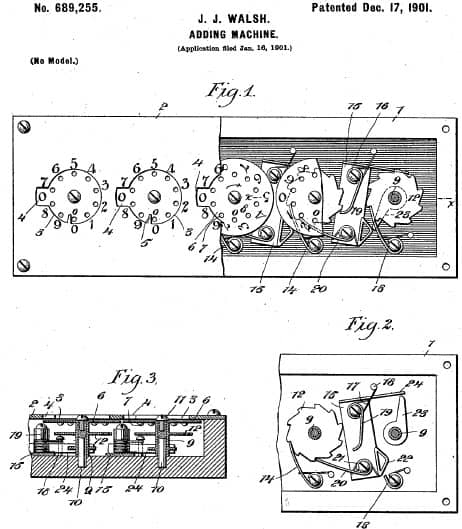
In 1901, James J. Walsh — an inventor from Elizabeth, New Jersey — patented an adding machine referred to as a “type dial adder.” This patent would eventually become the Calcumeter of James J. Walsh. A stylus-driven cogged wheel adder, the Calcumeter was first manufactured in 1901 by the company Morse & Walsh Co. of Trenton, New Jersey. This company was the joint venture of inventor James J. Walsh and business manager Herbert North Morse. It would eventually be renamed Herbert North Morse Co., but this doesn’t change the fact that Walsh’s invention was the company’s livelihood for nearly two whole decades.
Herbert North Morse was a New Jersey native who received his schooling at the South Jersey Institute in Bridgeton, New Jersey, and Harvard College in Cambridge, Massachusetts. In 1916, near the end of the Calcumeter’s manufacturing history, Morse not only owned the Calcumeter business but also served as assistant education commissioner for the state of New Jersey.
The timeline and the finer details of Walsh and Morse’s professional relationship remain murky over a century after the invention and eventual discontinuation of the Calcumeter, with many conflicting reports contesting various particularities about when they eventually disbanded and went their own separate ways. All in all, one thing remains clear: Walsh and Morse worked together for several years until Morse eventually took over a few years before the start of the 1910s. At this time, Walsh made changes to the device’s dial mechanism and rebranded the device under the name Standard Desk Calcumeter. Regardless of what changes were made to the device under Morse’s company’s name, it doesn’t change the fact that the Calcumeter is James J. Walsh’s creation through and through.
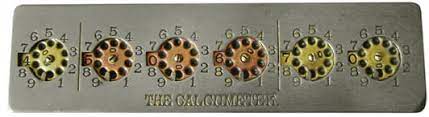
The Calcumeter featured five number dials on a rectangular device.
©History-Computer.com/History Computer Staff
Calcumeter of James J. Walsh: How It Worked
The Calcumeter of James J. Walsh worked via the turning of five number dials on the face of the small, rectangular device that resembled the size and the shape of a ruler. Those hoping to do some math with the Calcumeter would turn the dials using a stylus placed into one of the ten holes on the surface of the dial. On the left side of each dial, around the 9 o’clock position, a single digit between 0 and 9 would be exposed depending on the position of the said dial. Numbers 1 through 9 were also etched onto the metal case around the perimeter of all five dials.
To perform addition, users would position the desired digits one by one by turning each individual dial with the stylus. When a wheel was turned from 9 to 0, the Calcumeter would automatically perform a carry to the next wheel. Because the carry moved the wheel clockwise, only addition could be performed on the Calcumeter.
Variations on the Calcumeter of James J. Walsh come with anywhere from five to a dozen dials, each with a unique corresponding price point. For instance, a five-dial machine costs $10 with each additional dial increasing the price by $5. (This would mean that the 12-dial machine costs $45.) In 1907, Morse was manufacturing 48 different models and sizes for over 100,000 users. At some point around 1910, a reset dial was added and the machine was sold as the Standard Desk Calcumeter. This only increased sales of the device and added to the great success of Walsh’s historic invention.
Calcumeter of James J. Walsh: Historical Significance
What made James J. Walsh’s Calcumeter so historically significant was its one-of-a-kind look, its simple mechanism, its low price point, and its highly customizable design. At the time, Walsh would have had some competition from the likes of the Burroughs and Comptometer adding machines, but the Calcumeter still stood out from the pack because it was a fraction of the cost. There might not be any sort of adding device that looked like the Calcumeter before or after its invention, but that doesn’t mean that it wasn’t a landmark that changed the course of the history of the calculator for the reasons listed above.
The image featured at the top of this post is ©Unknown author / public domain